DNS Management
Built for MSPs
Manage client DNS across Cloudflare, GoDaddy, AWS Route53, NameSilo, OpenSRS, Porkbun, and more from one dashboard. Built specifically for Managed Service Providers.
Built by MSP veterans
We've managed 100+ client environments. We know the pain.
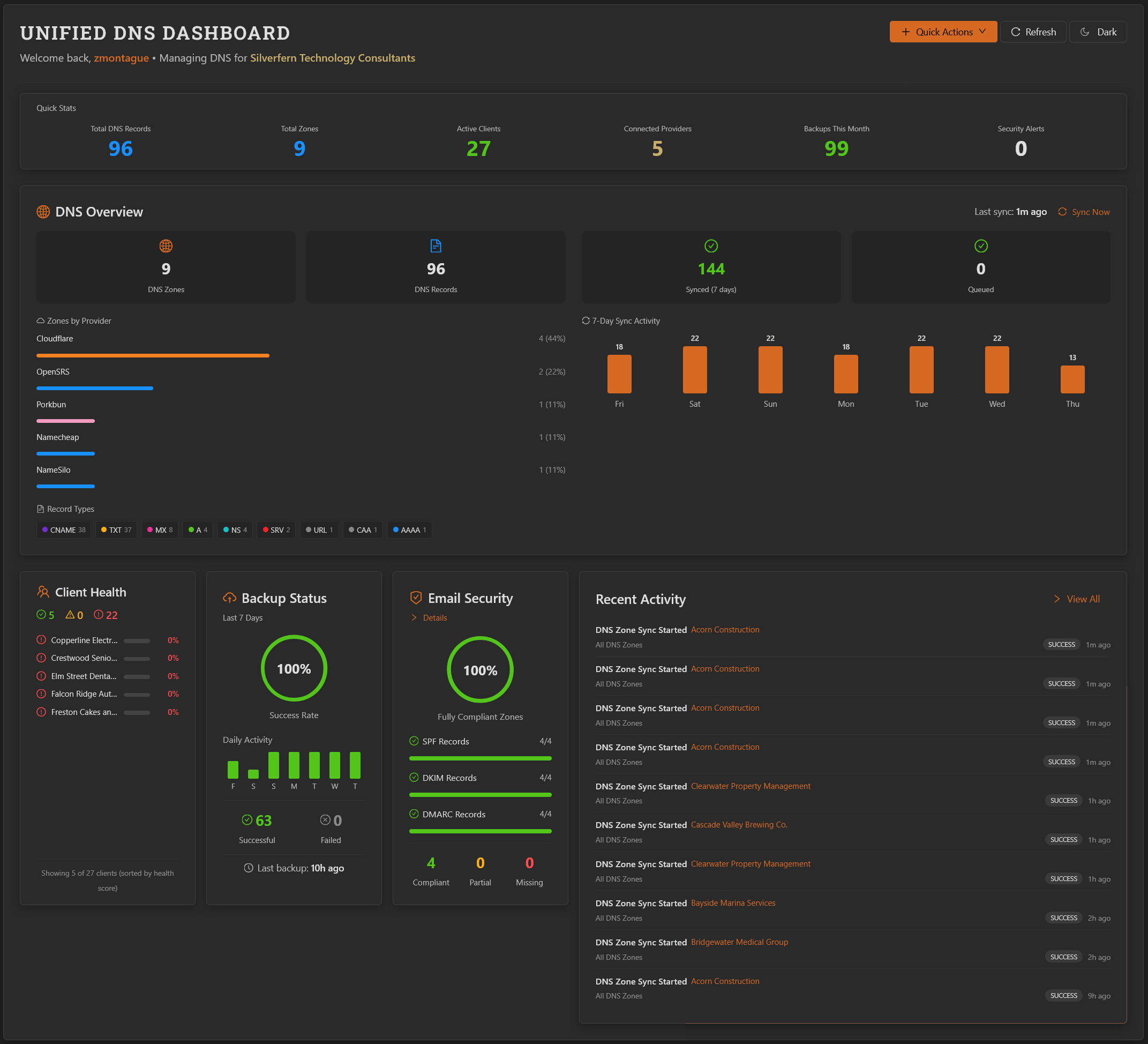
The DNS Management Nightmare Every MSP Knows
Sound familiar? You're not alone. These are the daily struggles that inspired us to build Unified DNS.
Scattered Logins
Logging into Cloudflare for Client A, GoDaddy for Client B, Porkbun for Client D, and so on for 50+ clients... hoping you remember which uses which.
No Backups
When did you last back up DNS records? Most MSPs can't answer because no tool in the space does it.
Doc Chaos
Keeping Hudu or ITGlue accurate is manual and tedious. Every provider has different formats.
Expiration Surprises
Do you know when ALL domains expire? One missed renewal can take down an entire business.
Watch, Can't Act
Monitoring tools alert you when something changes, then you still have to log into each provider to fix it.
DNS Orchestration for Every Provider
Unified DNS is the centralized control plane that brings every DNS provider you use — hosted or external — into a single, secure dashboard built specifically for how MSPs work.
Connect Without Being Forced to Migrate
Point Unified DNS at each client's existing provider account and manage every record from here. No migration required.
Automated Backups to Storage You Own
Scheduled backups to your own Azure Blob or SharePoint storage, saved as a BIND zone file and a settings JSON.
SPF, DKIM, DMARC, DNSSEC, CAA — At a Glance
See email authentication status across every client at a glance, before gaps turn into deliverability problems.
Organize by Client, Not by DNS Provider
See all zones and records for each client, regardless of which provider they use.
Know Who Changed What, When
Every action is logged and exportable for compliance, with retention configurable from 30 days to 2 years.
Renewal Alerts That Create Their Own Tickets
Alerts fire at 60, 30, 14, 7, and 1 day before expiry, and land as tickets in your PSA automatically.
Manage DNS, Don't Just Watch It
Most DNS tools are passive monitors that alert you when something changes. Then you still have to log into each provider to actually fix the problem. That's not management.
Passive Monitoring
- –Alerts you when records change
- –Still requires logging into each provider
- –No record editing capability
- –No backup or restore functionality
- –Watches problems happen, can't fix them
Active Management
- Edit records directly from one dashboard
- Never log into provider dashboards
- Full CRUD operations on all records
- Automated backups with one-click restore
- See a problem, fix it immediately
"Monitoring tools tell you what changed. Unified DNS lets you change it."
Built by MSP Veterans
We built Unified DNS because we lived the pain. Managing DNS across 100+ clients and 4 different providers taught us exactly what MSPs need — and what's missing from every other tool.
Security Built-In
MFA, full audit logging, session timeouts, and API credentials in encrypted vaults — never in the database.
No Lock-In
Your DNS stays with your providers. Backups in YOUR storage. If you leave, you keep everything.
Multi-Tenant Isolation
Each client's data is isolated. API keys stored separately per client — one can never access another's zones.
No AI, No Hallucinations
DNS needs predictable tooling, not AI guessing. Every action is deliberate, every result deterministic.
DNS Knowledge Hub
Deep-dive guides on DNS records, email authentication, and best practices for MSPs managing client domains.
TCP vs UDP: What's the Difference, and Why DNS Runs on Both
DNS lookups run on UDP for speed, but zone transfers, DNSSEC, and oversized responses fall back to TCP. A firewall that only opens one of the two causes exactly the kind of quiet outage that's hard to trace back to its cause.
Introducing UDNS Hosted: Authoritative DNS Built Into the Platform
Unified DNS now hosts authoritative DNS directly, on infrastructure built for MSPs — geographically redundant nameservers, three zone onboarding paths, DNSSEC, and audit-logged quick restore, all inside the same platform.
Domain Hijacking Isn't Rare Anymore: How MSPs Should Structure Client Domain Access
A client's registrar account gets compromised, the nameservers and MX records change overnight, and the MSP finds out when email stops working. Here's a practical framework for domain ownership, access control, and catching it before the client calls.
The Domains Nobody Thinks About Are the Ones Getting Abused
Parked and inactive domains rarely have SPF, DMARC, DKIM, or CAA records — making them easy targets for email spoofing and phishing. Here are the six DNS records every MSP should deploy on dormant client domains, and why each one matters.
Social Responsibility
Part of who we are, not a marketing exercise
Social responsibility isn't optional at Unified DNS. We believe in supporting causes that create real change, even when no one is watching.
Learn MoreRural Technology Fund
RejectionCon 2026 raised $80,000 USD for the Rural Technology Fund — bringing technology access to rural communities that need it most.
Unified DNS was proud to support RTF through direct donation and RejectionCon sponsorship.
Read the RejectionCon recap →Ready to Simplify Your DNS Management?
Unified DNS is live. Try it free for a month — no commitment.